
Clarion County Court Records After Arrest
In Clarion County, an arrest does not create the full court case by itself. The local custody path usually starts with transport and booking at Clarion County Jail when county detention is needed. The formal court-record path begins when a criminal complaint, preliminary arraignment, docket entry, bail order, or later charging document is filed in Pennsylvania's Unified Judicial System. That distinction matters because jail staff can answer whether a person is in custody, while the docket shows the charges and case events.
The Clarion County District Attorney's Office is the local prosecution office for criminal activity in Clarion County. The official county page lists District Attorney Drew Welsh and states that the DA is the final authority on what charges will be brought against an individual. That is why booking allegations may not match the filed court record. An arresting officer may list one set of suspected offenses, then the prosecutor may add, amend, reduce, withdraw, or proceed on different charges after review.
Custody records and court records answer different questions. For the jail side, use Clarion County jail inmate records when the question is whether someone is booked, released, transferred, or still held. For booking photos, use the Clarion County jail mugshots page because a criminal docket does not serve as a mugshot gallery. For charges, bail, hearings, warrants, and dispositions, use UJS Case Search, PAeDocket, the court office shown on the docket, and, where needed, Pennsylvania State Police ePATCH.
Search Clarion County Court Records
The main online access point for court records after a Clarion County jail arrest is UJS Case Search. The Unified Judicial System says public web docket sheets cover Pennsylvania appellate courts, criminal courts of common pleas, magisterial district courts, and Philadelphia Municipal Court. For Clarion County arrest cases, the useful records are usually magisterial district court dockets for the early complaint and preliminary hearing stage, plus Court of Common Pleas dockets if charges are held for court.
The official UJS case information page also describes PAeDocket, a free mobile route to public docket data. PAeDocket is available through the Apple App Store and Google Play. It is relevant when a phone is easier than the web portal, and it can search by case number, participant name, organization name, offense tracking number, police incident or complaint number, or state ID number. It is not a live jail roster, and it does not prove a person is still in the Clarion County Jail.
The UJS case-search screen is shown on the official Pennsylvania court portal at UJS Case Search.
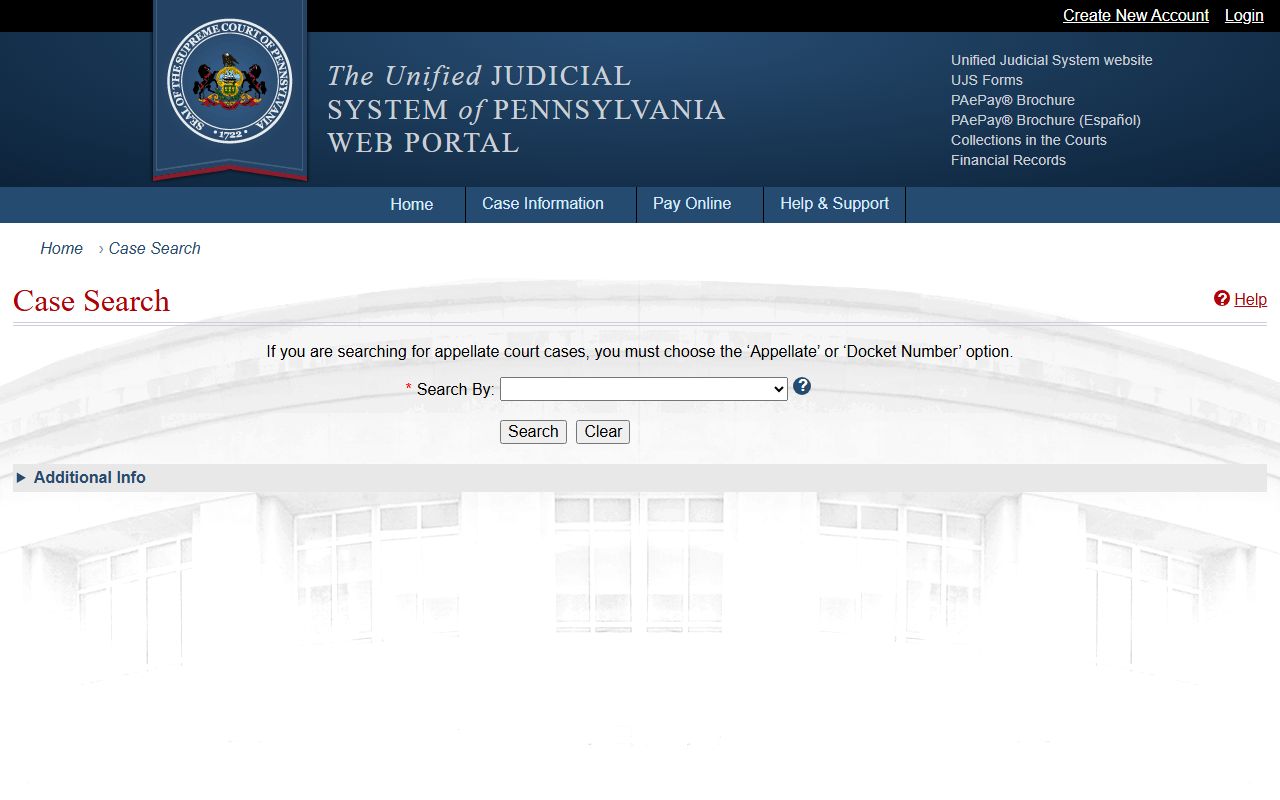
Use the court portal for dockets and use the jail phone line for current custody, because recent filings and recent releases can move on different timelines.
| Field Label | Type | Required | Options / Format Notes |
|---|---|---|---|
| Docket number / case number | Text | Optional | Best for a direct lookup when the court number is known. |
| Participant name | Text | Optional | Search by defendant or other named participant. |
| Organization name | Text | Optional | Available through PAeDocket for organization-based searches. |
| Offense Tracking Number | Text | Optional | Useful for linking an arrest or complaint to the court docket. |
| Police incident or complaint number | Text | Optional | PAeDocket supports this field when the number is known. |
| State ID number | Text | Optional | Another PAeDocket search path for criminal case matching. |
| County / court | Dropdown or filter | Optional | Narrow to Clarion County where the portal offers a county or court filter. |
UJS access has limits. The judiciary warns that recent entries made in filing offices may not appear right away, public docket sheets do not replace a criminal-history background check, and some older magisterial district court cases may disappear from the public web docket after retention rules allow paper records to be destroyed. For an official statewide criminal-history check, use Pennsylvania ePATCH, the Pennsylvania State Police criminal history record check portal.
Arrest to Court in Clarion County
The usual path is arrest, booking, preliminary arraignment, bail decision, preliminary hearing or waiver, formal prosecution, and then plea, trial, dismissal, ARD, sentencing, or another disposition. A person may be held at Clarion County Jail during parts of that path, but the court record is maintained through the court system. Municipal police departments in the county may make arrests, and the sheriff serves warrants and court orders, but neither function turns the sheriff page into a court docket.
- Search UJS Case Search or PAeDocket by name, docket number, OTN, complaint number, or incident number.
- Open the docket and confirm the court level, county, defendant name, docket number, filing date, and listed charges.
- Read each charge line for grade, statute, status, and later disposition.
- Check docket entries and calendar events for arraignment, preliminary hearing, common pleas action, bail changes, or bench warrants.
- Call Clarion County Jail at (814) 226-9615 only for current custody, release, transfer, or jail-status questions.
The simple flow is: arrest > booking > preliminary arraignment > complaint and docket > DA review > formal charges or disposition. If the docket and jail disagree, they may both be correct for different moments. A court docket may lag a new booking, and a jail release may occur before every public docket note is updated.
Note: PAeDocket is the court-record mobile app found in the research; no Clarion County sheriff or police roster app was located.
Clarion County Charging Documents
Charging documents are the bridge between an arrest and the court record. In a new Clarion County criminal case, the first public docket may start with a complaint at the magisterial district court level. If charges move forward, the Court of Common Pleas record may show formal prosecution by information. Indictments are possible in Pennsylvania criminal practice but are not the usual document for ordinary county cases, so the complaint and information matter most for day-to-day docket review.
| Document | Who Usually Files It | Where It Fits | What to Check |
|---|---|---|---|
| Complaint | Police officer or prosecutor | Early magisterial district court stage after arrest | Initial charges, OTN, affidavit references, preliminary arraignment, and bail. |
| Information | District Attorney | Common pleas stage after preliminary proceedings | Formal charges the prosecutor elects to pursue. |
| Indictment | Grand jury process | Less common for routine county prosecutions | Whether a grand-jury charging route appears on the docket. |
Drew Welsh's office is important because the DA page says the prosecutor is the final authority on what charges will be brought. That does not mean the DA office is a general public help desk for private case research. It means the filed court record should be treated as stronger than a rumor, jail intake note, or third-party arrest list when determining what the Commonwealth is actually pursuing.
Clarion County Charge Status Records
Charge status is the part of a court record that changes most often after a jail arrest. One charge can remain pending while another is dismissed. A felony can be held for court, reduced, or amended. A prosecutor can decline to continue on a charge through nolle prosequi, often shortened to nol pros. A disposition is the outcome of a charge or case, such as guilty plea, trial verdict, dismissal, ARD-related result, or sentencing entry.
| Status | Plain Meaning | Why It Matters |
|---|---|---|
| Pending | The charge is unresolved. | No conviction has been entered on that charge. |
| Amended | The charge text, grade, statute, or count changed. | Compare older and newer docket entries before relying on the first list. |
| Reduced | The severity or charge level was lowered. | A jail booking allegation may look more serious than the later court record. |
| Dismissed | The court is not proceeding on that charge. | Dismissal is not the same as expungement from all public records. |
| Nolle prosequi | The prosecutor declines to continue that charge. | The docket may still show the charge history and status. |
| Disposition | The outcome of a charge or case. | Use the disposition, not the arrest label alone, when reading the case result. |
Bail and Warrants After Arrest
Bail and release conditions in Pennsylvania are set by a judicial officer, not by the jail or the family. Clarion County records may show release on recognizance, unsecured bail, nominal bail, percentage or cash bail, surety bail, nonmonetary conditions, or no release when another hold applies. The UJS portal can show court costs, bail, restitution, traffic tickets, and related payment paths through the official judicial system, but inmate-account money and bail are separate systems.
Before money is posted or travel plans are made, confirm both the court order and the custody hold. A person can remain in Clarion County Jail despite a bail amount if there is a bench warrant in another docket, probation or parole detainer, out-of-county hold, state DOC transfer order, federal hold, ICE detainer, or new charge. Jail staff can verify custody, while the docket explains the court event that created or changed the order.
| Release or Hold | How It Works |
|---|---|
| Recognizance release | Release based on a promise to appear and obey conditions. |
| Unsecured bail | No upfront payment, but a stated amount may become due after violation. |
| Cash or percentage bail | Money is posted through the proper court or approved payment channel. |
| Surety bail | A surety or bail agent backs the bond under court rules. |
| Detainer or hold | Another agency or docket prevents release even when one case has bail. |
The Clarion County Sheriff's Office serves warrants, PFA orders, court orders, and civil papers. No official online active-warrant search was located in the research. For sheriff-served warrants, the official local contact is the sheriff's office. For a docket that may show a bench warrant, failure to appear, bail change, or hearing event, search UJS or PAeDocket.
Clarion County Records: Charge vs. Conviction
A charge is an accusation in a court case. A conviction is an outcome after a guilty plea, trial verdict, or other qualifying disposition. Treating the two as the same can lead to serious errors, especially soon after a jail arrest. UJS dockets can show the charge history, but the Pennsylvania judiciary warns that public docket sheets should not replace a criminal-history background check. ePATCH is the statewide criminal-history path for that purpose.
| Point of Comparison | Charge | Conviction |
|---|---|---|
| Meaning | An allegation filed in a criminal case. | A final finding or plea that results in guilt on a count. |
| Timing | Often appears soon after complaint or formal filing. | Appears only after plea, verdict, or qualifying disposition. |
| Proof level | Based on accusation and court screening. | Requires proof, plea, or legal admission under court rules. |
| Record use | Useful for tracking the case, not proof of guilt. | Stronger outcome record, but still must be read with sentence and appeal status. |
Important: Do not use public docket or custody pages for employment, credit, housing, insurance, or other FCRA-regulated decisions.
Clarion County Sealed and Expunged Court Records
Some court records after an arrest may be limited, sealed, unavailable on the public web docket, or removed through expungement. Pennsylvania's Right-to-Know Law creates a request process for public agency records, but it also has exemptions. The county open-records page lists categories that may be unavailable, such as confidential informant identities, home addresses of law enforcement and judges, and records involving minors or protected social-service information.
Pennsylvania's Right-to-Know Law governs many county public-record requests. Pennsylvania CHRIA governs criminal history record information. 18 Pa.C.S. § 9122 sets Pennsylvania expungement rules for eligible criminal history record information. These are different tools, and none should be read as a promise that every arrest record disappears after dismissal.
| Point of Comparison | Sealed or Limited Access | Expunged |
|---|---|---|
| Public visibility | Restricted from public view in qualifying situations. | Removed or destroyed as ordered by the court under applicable law. |
| Who may still see it | Some courts, agencies, or authorized users may retain access. | Access is much more limited, depending on the order and statute. |
| Common reason | Limited-access rules, protected record type, or sealed proceeding. | Statutory eligibility after certain outcomes or time periods. |
| Where to verify | UJS public-access rules and the court office shown on the docket. | The court order and Pennsylvania expungement statute. |
For Clarion County records that do not appear online, start with the docket office shown in UJS, then use Clarion County Open Records when the requested item is a county-held public record rather than a court docket. The county lists a five-business-day response deadline and a possible thirty-calendar-day extension for Right-to-Know requests.
Limits on Clarion County Court Records
Not every record tied to an arrest is public, complete, or current online. Juvenile matters, sealed records, expunged records, secure docket sheets, active investigative materials, and certain personal data may be restricted. UJS public docket sheets can be printed and searched for free, but secure docket sheets and calendars require authorized access and may contain content unavailable to the public.
- OTN
- Offense Tracking Number, a Pennsylvania identifier that can link an arrest, complaint, and court docket.
- Preliminary arraignment
- An early court appearance where charges and release conditions may first be addressed.
- Detainer
- A hold from another agency or docket that can block release from jail.
- Disposition
- The outcome of a charge or case, such as dismissal, plea, verdict, or sentence.
For statewide criminal history, ePATCH is the official Pennsylvania State Police route. For current custody, Clarion County Jail is the direct source. For court records after a jail arrest, UJS Case Search and PAeDocket remain the public starting point, with the court office shown on the docket handling older, corrected, or non-web records.
Public Record Search
Sponsored Results